Scattered Tongues HQ

This conlang site belongs to Paulo Eduardo França Padilha.
List All | Random | HQ
Prev | Next | Next 5

visit the Kingdom of Kaupelan


Português


Basic Grammar

Kaupelanese-English Dictionary

Kiwangar Writing

Institute of Languages


Introduction

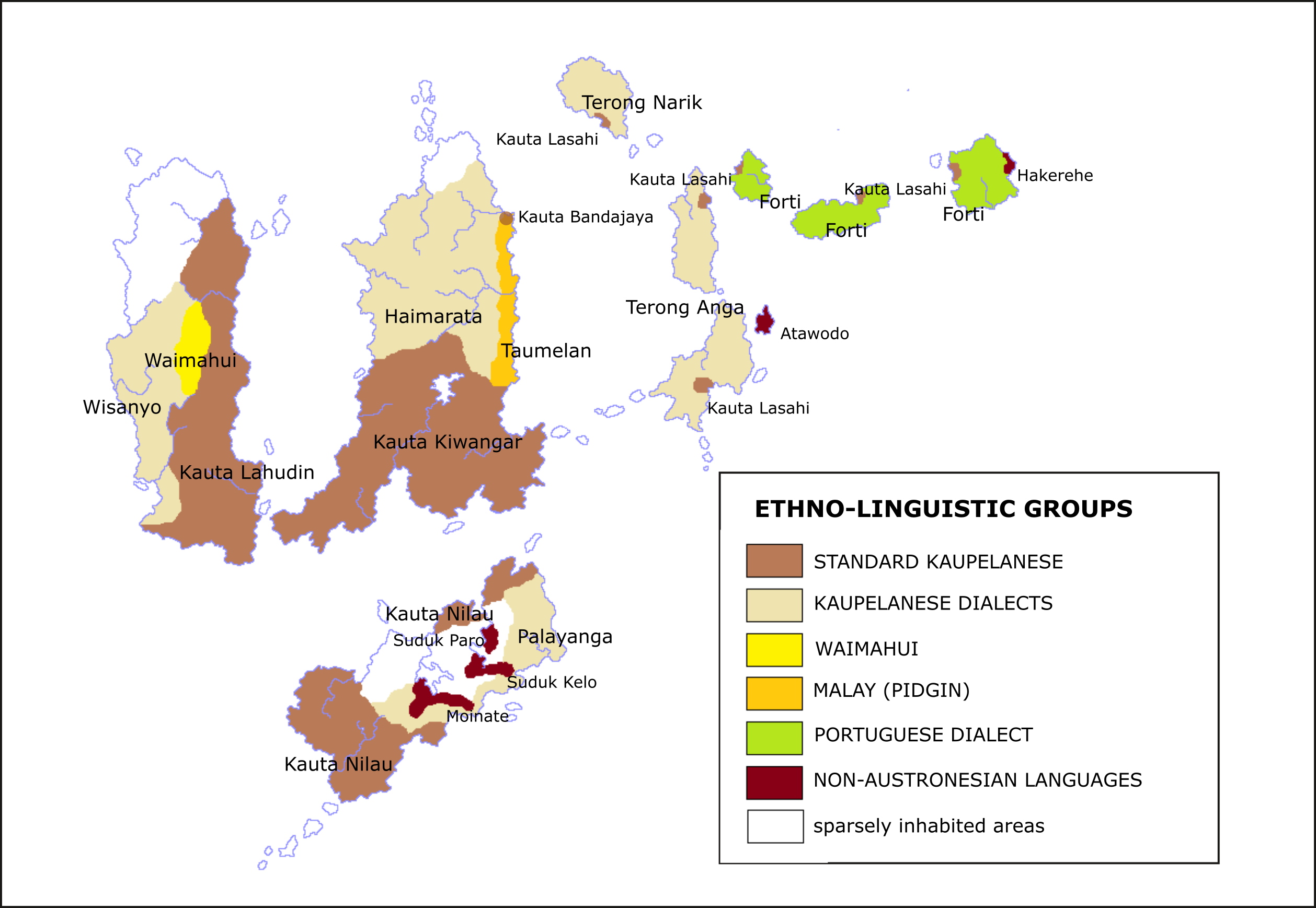
Kaupelanese, or basa kaupèlan, is the mother tongue for the majority of the people in Kaupelan and, beside English, the official language of the Kingdom of Kaupelan. It is an Austonesian language descendant of makuwa (or old Kaupelanese), the lingua franca of the archipelago in the fifteenth century. Kaupelanese has five dialects, Kauta (the standard form), Haimarata (spoken in northern Kiwangar), Wisanyo (spoken in western Wisanu), Palayanga (spoken in Nilau) and Terong (spoken in Terong islands).

Kaupelanese is written in its own alphabet, kiwangar, derived from an ancient script introduced in Kaupelan by Hindu priests in the tenth century. By influence of European colonizers, Roman alphabet is also largely employed. Since 1960, an official trasliteration to Roman writing was adopted, replacing the existing variants. This version considers basically the phonetics of English consonants and Portuguese vowels.


History and Classification

Kaupelanese belongs to the Austronesian language family like, for example, Malay, Javanese, Tagalog, Malagasy and the Polynesian languages. Inside this family, it is classified as belonging to the following subdivisions: Malayo-Polynesian; Central Eastern; Central Malayo-Polynesian and Bandanic. Seven living languages and 17 dialects belong to the Bandanic group. Inside this group, Kaupelanese is included in Eastern Bandanic subgroup.

According to lexicostatistical studies, the first Austronesian populations arrived to the archipelago three thousand years ago. Since then, its language suffered strong influence of aboriginal languages that led to the differentiation of Bandanic languages spoken today. Scholars try to reconstruct the first Austronesian language spoken in the archipelago, the Proto-Bandanic (PBN), based on the languages and dialects of the Bandanic group. Though PBN did not have script, its words can be inferred by comparing its descendant languages and by using Old Kaupelanese, the only ancient languages of the group with written records. Thus, for example, the Kaupelanese words aji (‘rain’), nguwa (‘strong’) and rau (‘two’) are derived from the Old Kaupelanese words ajet, nguwat and rao and are akin to the words asit, not and döi from Waimahui, another language of the group. The corresponding PBN words can be inferred as *’azet, *ngowat and *dewe.

With the dispersion of Austronesian population throughout the archipelago, many dialects derived from this protolanguage. These dialects, which already had influences of non-Austronesian languages, were adopted by local communities and absorbed lexical and grammatical characteristics of different aboriginal speeches. The Bandanic dialect spoken in the south of Kiwangar – which would originate Kaupelanese – showed a significant linguistic substratum attributed to a non-Austronesian language, the so-called Old Hubian (OH). From words like kiyawa (‘magic power’), sawa (‘potion’), silempi (‘bee’) and kuwimpi (‘ant’), for example, it is extracted the OH roots *awa (‘magic’) and *impe (‘insect, bug’). So, kiyawa is supposed to be derived from OH *k-i-awa (‘his magic power’), as well as sawa from *se-awa (‘magic liquid’), silempi from *sila-impe (‘honey bug’) and kuwimpi from *kuru-impe (‘earth bug’).

Old Kaupelanese (until 1400) – The language in its earliest phase is called Old Kaupelanese (OK), or basa makuwa. The language of this period had a special feature: two distinct forms used according to the social class of the persons involved in the conversation. So, there was the Noble Speech, or basa raja, a refined language used exclusively by the royal family and the nobles; and the Common Speech, or basa daqè, used by the people in general. The Noble Speech was considered the classical and literary form and it has, from the introduction of writing in the tenth century to the beginning of the fifteenth century, a remarkable literary production. The texts, mostly about the local nobility and religious matters, used euphemistic phrases and a large amount of Sanskrit and Old Javanese loanwords. But it was the basa daqè that spread outside the kingdom of Kaotamakuwa, specially due to traders and soldiers, to become the vehicular language of the sultanate of Rajakaopalan and that decisively contributed to the Modern Kaupelanese.

Here is an example of phrase construction in basa raja:

Ridi amana na ridi dah mayita putri qae rao qi qame kaotana.

My father and me saw two little girls in our hamlet.

Middle Kaupelanese (from 1401 to 1800) – The dialect of basa daqè spoken in Kiwangar from the fifteenth century on is considered the Middle Kaupelanese, or basa kiwangar. The language received more influences of aboriginal speech and the lexicon was enriched with words from Malay and Arabic. Basa raja was no longer used as written standard, except by some priests or sages, as a kind of ritual or formal language. Both Kiwangar and an Arabic-based alphabet are employed in this period. The language began to diverge throughout the archipelago in a process that would generate the dialects Wisanyo, Palayanga and Terong.

New Kaupelanese (since 1801) – The latest version of Kaupelanese – that is considered the standard form of the language spoken today – is the dialect of southern Kiwangar. In fact, basa kiwangar originated two different dialects, one Islamic in the north, called Haimarata, with greater Arabic and Malay influence, and the other Christian in the south, Kauta, with accentuated Portuguese and English influence. The Kauta dialect was adopted as the national language since 1960.


Phonology

The Kaupelanese phonology is relatively simple. The following consonants can occur: b, d, g, j, p, k, m, ng, n, t, h, f, l, r, s, w and y. The sound of ge and gi is as in 'get' or 'give'; ng (as in ‘singing’) can also initiate a word; k sounds like a glottal stop (as in the interjection ‘oh-oh’) when not followed by a vowel; r is trilled like the r in Spanish; s sounds always like s in 'sister' even between vowels. The vowels are a (as in ‘father’), e (as in ‘electronic’), è (as in ‘the’), i (as in ‘edition’), o (closed as in ‘local’) and u (as in ‘rule’). The diphthongs are au (like ‘now’), ai (like spice) and ui (as in ‘ruin’).

Generally the stress is in the penultimate syllable (as in ngaja, ‘group’, or etim, ‘hair’). Exceptions are è in the penultimate syllable (as in kaupèlan) and diphthongs in the last syllable (as in ajimai, ‘snow’, or aijau, ‘beyond’). In those cases, the stress is in the last syllable.


Grammar

Kaupelanese is not a complex language. There are no declensions and the words are not inflected regarding gender or number. The same word can be noun, adjective or verb. The verbs are conjugated to person by using personal prefixes. Tense and mood are given by auxiliary words. So, for instance, in the phrase au aman na au dahuk wita sèngurita, ‘my father and me saw the girl’, to the verb ita (‘see’) is added the prefix w- (first person). The word dahuk is used to indicate the past perfect. The possessor always antecedes the possession. The suffix –n is normally added to the possession as in the previous example, when –n was added to ama (‘father’) to make au aman (‘my father’).

Dialects

The phrase ‘my father and me saw two little girls in our hamlet’ is exemplified in the different Kaupelanese dialects:

Au aman na au dahuk wita sèngurita lau rau hi hami paliman

Standard Kaupelanese (Kauta)


Ridi aman a na ridi dau’ wita puri lau rau i ami desan a

Haimarata


Riji aman ma riji dah menyita hitji qa rèu qi qame sahn

Wisanyo


Au aman na au dah uhita faga hé ró hi ham paliman

Palayanga


Au ama na au da yita seyorita ibi ro ’i ’ami wila

Terong


OTHER LANGUAGES OF KAUPELAN


Atawodo

Atawodo is a non-Austronesian language spoken in the small island of Homafak by only 1,000 people in a bilingual community. It is the most endangered language of Kaupelan. It is classified as a Trans-New Guinean language, belonging to South Bird’s Head-Timor-Alor-Pantar, Alifuro, Central and Hubi subdivisions. It is related to Old Hubian and Belahu languages, spoken in Kiwangar before the arrival of the Austronesian people. It is also related to Libaru, the ancient language of Wisanu and Suduk, spoken in Nilau.

As an example, the phrase ‘my father and me saw two little girls in our hamlet’ becomes wadai na wo nambadu’e ibe dà wite wotai wodo de in Atawodo.


Forti

Spoken in the eastern islands of Terong archipelago by about 30,000 people, Forti is a creole of Portuguese, introduced in those islands in the 16th century. It has influenced the Kaupelanese dialect spoken in the eastern islands, Terong.

As an example, the phrase ‘my father and me saw two little girls in our hamlet’ becomes min pai e min foi beh dous sèyorita pèken i nos bila in Forti.


Hakereh

Hakereh, spoken in the East of Hakereh by approximately 2,000 people is one of the non-Austronesian languages of Kaupelan. It is classified as a Trans-New Guinean language, belonging to South Bird’s Head-Timor-Alor-Pantar, Alifuro and Matutu-Hakereh subdivisions. It is derived of Matutu-Hakereh language, spoken in the eastern Terong islands in ancient times. Nowadays, it is considered an endangered language.

As an example, the phrase ‘my father and me saw two little girls in our hamlet’ becomes num aitah em num uk longo malongong behmahit numuk elohih in Hakereh.


Moinate

Moinate, spoken in Central and Southwestern Nilau by about 17,000 people, is the most divergent non-Austronesian language. Nowadays it is classified as belonging to an isolate group of South Bird’s Head-Timor-Alor-Pantar branch of Trans-New Guinean phylum, influenced by some very ancient Austronesian tongues. Moinate was strongly influenced by Suduk and, lately, by the Kaupelanese dialect spoken in Nilau.

As an example, the phrase ‘my father and me saw two little girls in our hamlet’ becomes ma rame ge me ma tu otem je ram daje dan te eujadi in Moinate.


Suduk

Suduk, spoken in central and eastern Nilau by around 13,000 people, is a non-Austronesian language of the Trans-New Guinean phylum, classified as belonging to the South Bird’s Head-Timor-Alor-Pantar branch and to Alifuro, Central and Southern subdivisions. It is related to Atawodo and to the ancient non-Austronesian languages of Kiwangar. There are two dialects, Suduk Kelo or High Suduk, spoken in the central highlands and Suduk Paro or Low Suduk, spoken in the Southeastern coast. Suduk was slightly influenced by the language of the ancient realm of Tjanwadulan and lately, by Kaupelanese.

As an example, the phrase ‘my father and me saw two little girls in our hamlet’ becomes datjil ma ani nandeditjein lud faga lafe nani tjanti in High Suduk and dafah ma ani nandèdisain dud faga dame nani santi in Low Suduk.


Taumelan

Taumelan is a kind of pidgin language spoken in the eastern and northeastern Kiwangar by approximately 170,000 people. Its basic structure and vocabulary are derived from Old Malay spoken in Maluku in the eighteenth century. It has a substratum from Belahu, an ancient aboriginal language of Kiwangar and a strong influence of Old and Modern Kaupelanese. Some Arabic words are found in this language due to the Muslim religion.

As an example, the phrase ‘my father and me saw two little girls in our hamlet’ becomes Amaku dang beta dauk mliyat dua puri aim di desa ami in Taumelan.


Waimahui

Although Waimahui, spoken in the mountains of central Wisanu by about 30,000 people, is closely related to Kaupelanese, both languages are not mutually intelligible. Waimahui is classified as belonging to Austronesian language family and included in the following subdivisions: Malayo-Polynesian; Central-Eastern; Central Malayo-Polynesian; Bandanic; Central; Eastern.

As an example, the phrase ‘my father and me saw two little girls in our hamlet’ becomes no aman ma ao otna mlita hytji ma’a döi ’i ’am sa ’a in Waimahui.


******

Whether you want to know more about Kaupelanese language or any other language of Kaupelan or whether you have any comment, suggestion or correction to do, please write to kaupelan@hotmail.com.


UNI TAU YALEK SUKU UNI YARTI ADI

Kidai hau yalek suku uni harti sulai adi na amu howaiwasa duhu hi basa kaupèlan, kina hosulai ai kaupelan@hotmail.com. Hami kimalmai sahera uni uwairasi ai hau. Kenina hau tau yanarik hi dara ina yarti basa kaupèlan luwa hami tanan. Ngi yahumai, hami amu utulu hate waiwasa sai (chat group) hi basa kaupèlan.


Visit the pages of:

Kaupelanese Institute of Languages